
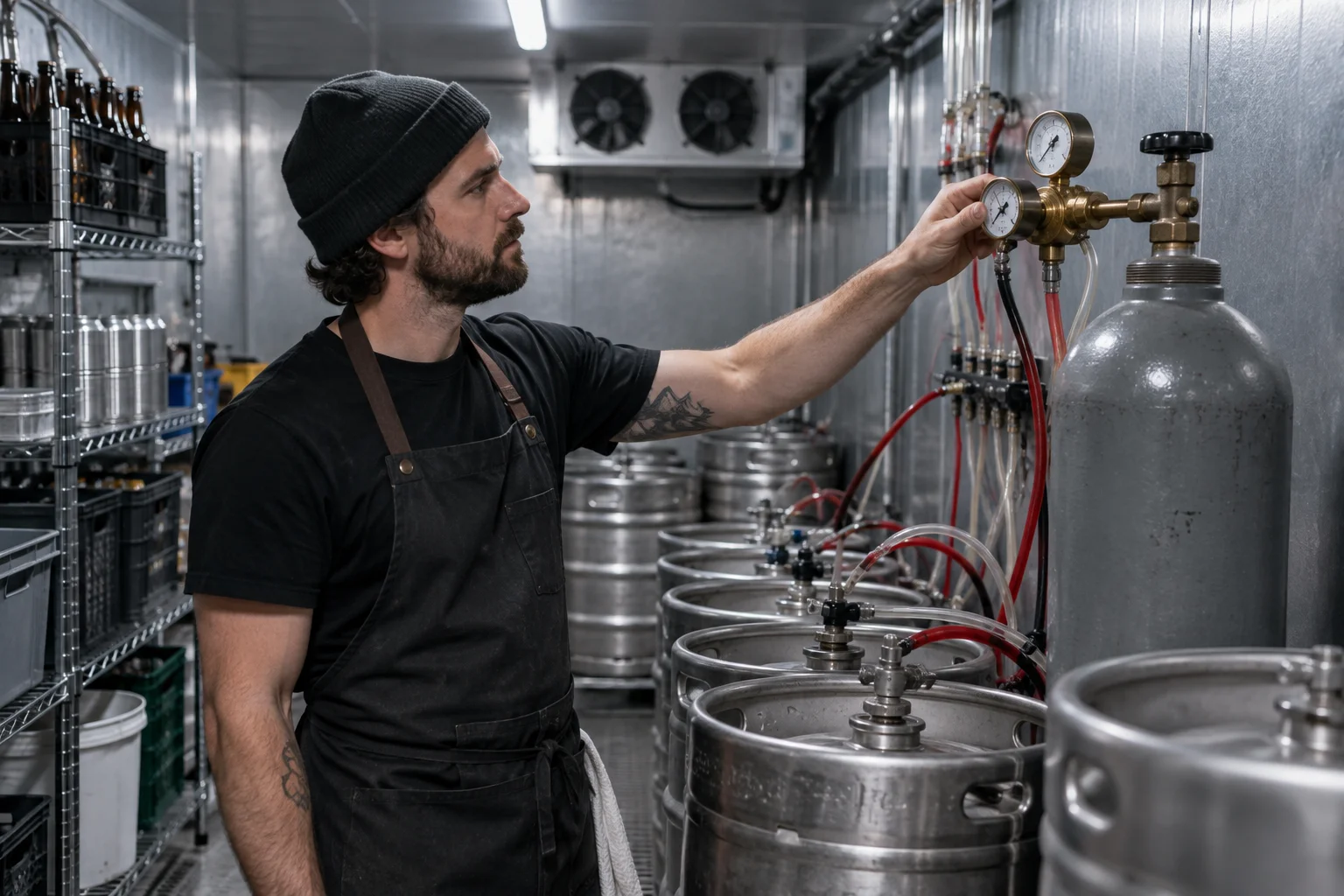
Why is my keg beer flat? Most often the regulator is set too low, the CO2 cylinder is close to empty, or the keg is too warm to hold carbonation. This guide helps you find which one in a few minutes, then fix it. A reliable Beverage Gas Supply setup takes the gas side off the list of suspects.
Why Is My Keg Beer Flat? The Six Usual Causes
Draft beer goes flat when carbon dioxide (CO2, the gas that makes the bubbles) leaves the liquid faster than the gas above it can hold it in. Carbonation is a balance between pressure and temperature. Lower the pressure or warm the keg, and the CO2 escapes from the beer. The pint then looks lifeless and tastes flat. Most bars and breweries hit one of six causes, and the table shows how to spot each one.
| What you see | Likely cause | Who usually fixes it |
|---|---|---|
| Pressure low on the regulator gauge | Regulator set too low, or a slow gas leak | Your bar team |
| Gauge drops fast, then the tap spits | Empty or nearly empty CO2 cylinder | Swap the cylinder |
| Foam first, then flat pours | Warm beer lines, a kink in a line, or a warm keg | Bar team or draft installer |
| Beer tastes flat but the gauges look normal | Wrong gas, such as a nitrogen blend on a beer meant for CO2 | Ask your gas supplier to switch you to the right gas |
| Only one tap pours flat | Faucets, coupler or beer line on that tap | Draft installer |
| Every tap flat after a busy weekend | Cooler drifted warm, or the regulator got knocked | Bar team |
Only the first two rows are pure gas problems. The rest live in the cooler or the rest of the beer system: couplers (the fittings that lock onto a keg), faucets and beer lines. Green CO2 Systems supplies the gas. Your draft installer owns the faucets and lines, so call them when the clues point there.
Flat Draft Beer: How Do You Tell If It's the Keg, the Lines, or the Gas?
Flat draft beer has three suspects: the keg, the beer lines and the gas. When a bartender asks, 'Why is my keg beer flat?', run these five checks in order. Each takes about a minute and rules out a whole group of causes.
- Read both regulator gauges. The high-pressure gauge shows what is left in the cylinder. On a liquid CO2 cylinder it stays near full until the cylinder is almost empty, then drops quickly. The low-pressure gauge shows what reaches the keg. If it reads zero, no gas is getting to the beer and every tap will go flat. Skip this check and you can spend an hour on beer lines while an empty cylinder is the whole problem.
- Check the cooler temperature. Keg beer should sit near 38°F. Warm beer cannot hold its CO2, so it foams at the tap and then pours flat.
- Compare the taps. If only one tap pours flat, the gas supply is fine and the trouble is that keg, its coupler, its faucets or its beer line. A kink in a line or a loose coupler will do it. If every tap is flat, look at the gas and the cooler.
- Spray the fittings with soapy water. Bubbles mark a leak at a regulator connection, hose or coupler. A slow leak drains the cylinder and drops pressure, so the beer slowly loses carbonation.
- Tap a fresh keg on the same line. If the new keg pours well, the first keg was old, warm or under-carbonated. If the new keg also pours flat, the problem is in the gas or the setup.
CO2 is heavier than air and can collect in a closed cooler or cellar. If you hear hissing or feel dizzy or short of breath, leave and ventilate the space before you troubleshoot anything else.
How Does CO2 Pressure and Temperature Affect Keg Carbonation?
Cold beer holds more CO2 than warm beer, and higher pressure pushes more CO2 into the liquid. Carbonation stays steady only when the two match. The table shows the psi (pounds per square inch, the unit on your regulator gauge) that holds about 2.5 volumes of CO2. Volumes measure how much gas is dissolved, and many lagers and ales sit between about 2.2 and 2.8.
| Beer temperature | Approximate psi to hold 2.5 volumes |
|---|---|
| 34°F | 9 |
| 36°F | 10 |
| 38°F | 11 |
| 40°F | 12 |
| 45°F | 15 |
Read it as a starting point, not a law. The regulator also has to push the beer through the lines, and line length and diameter change how much pressure the beer needs. Balancing line length is a draft installer's job. If the beer pours foamy at the right psi, line length and warm beer lines are the next suspects.
Temperature swings cause more flat beer than any single part. A cooler that drifts from 36°F to 46°F over a weekend lets the keg shed CO2 into the space above the beer. On Monday the beer tastes flat even though nobody touched the regulator.
CO2 Regulator Beer Troubleshooting: What Should the Regulator Be Set To?
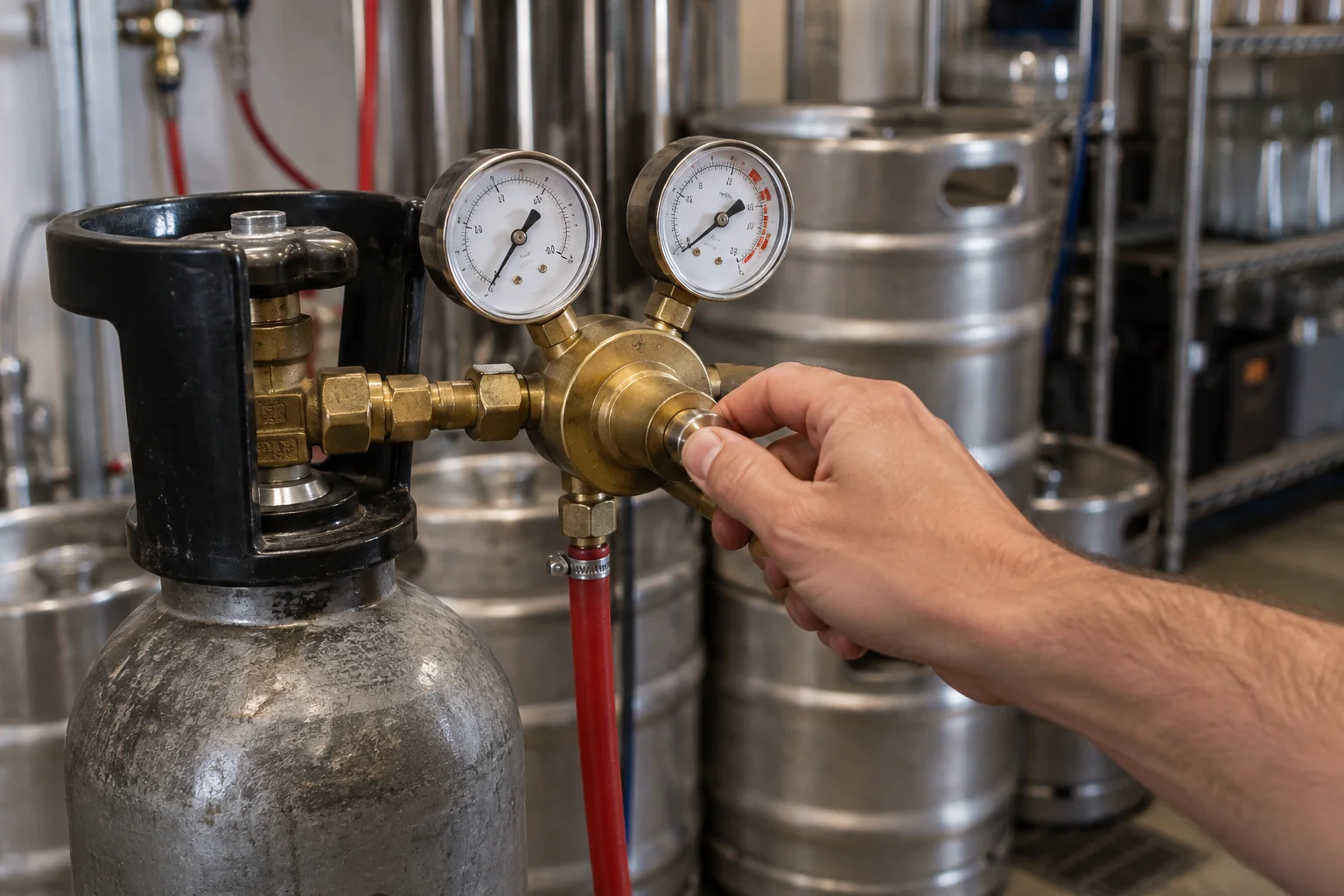
Set the regulator to the psi that matches your cooler temperature. At 38°F that is usually 10 to 12 psi for ales and lagers. Stouts and other beers served on nitrogen blends run a different gas at a higher pressure, so follow the brewery's guidance instead of guessing. Then work through these regulator checks:
- Screw turned in, gauge will not rise. The cylinder valve is closed, the cylinder is empty or the regulator has failed. Open the valve slowly and check the cylinder gauge first.
- Pressure low once the keg is connected. Gas is going somewhere. Check the coupler, the hose and the fittings with soapy water. If the pressure is low only after the keg is attached, suspect the coupler.
- Pressure creeps up overnight. A regulator that creeps, rising with the valve set and nothing flowing, over-pressurizes the keg and makes the beer foamy. Replace it.
- Gauges look normal but the beer tastes flat. Look at cooler temperature, gas type and keg age, not the regulator.
If you are changing cylinders more often than you expected, ask about CO2 Tank Refill by Cylinder Exchange, where you swap an empty cylinder for a full one and telemetry on every account tracks cylinder levels.
Beer Not Carbonating in Keg: What Causes It and How Do You Fix It?
A keg that will not carbonate has the same problem as one that went flat: CO2 is not dissolving into the beer. Breweries see it most, because a keg filled and left at cellar temperature with the gas off will not carbonate until pressure, cold and time line up. The causes and fixes are short:
- Not enough pressure. Set the regulator to the psi your beer temperature calls for, using the table above.
- Beer too warm. Warm beer accepts very little CO2. A full keg can take a day to chill all the way through, so cool it first.
- A leak at the keg or the coupler. Gas escapes as fast as it enters. Check the keg lid seal and the coupler with soapy water.
- Not enough time. Carbonation takes days, not hours. The timing section below gives the range.
- The wrong gas. Nitrogen is inert in these applications, so it does not carbonate beer. Carbonation needs CO2. Two gasses run most draft systems, straight CO2 and a CO2 and nitrogen blend, and each beer is meant for one of them. Check the label on the gas cylinder against the beer.
Flat Keg Beer Fix: How Do You Get a Flat Keg Pouring Right Again?
A flat keg beer fix has two parts. First remove whatever caused the loss. Then give the beer time to take CO2 back. Skip the first part and the next keg goes flat the same way.
How to Revive Flat Beer?
- Fix the cause. Swap the empty cylinder, tighten the leaking fitting or bring the cooler back to 38°F. Without this, nothing below sticks.
- Set the regulator to the right psi. Use the table above, or the brewery's number. Too low and the beer never recovers.
- Leave the keg cold, still and on gas for at least 24 hours. Moving a keg stirs up sediment and gives you cloudy beer on top of flat beer.
- Pour a small sample. If the beer still tastes flat, give it more time. Many fixes need two or three days at the correct pressure.
- Resist the big bump. Raising the pressure by 2 to 3 psi for a day or two can speed things up. Going higher and leaving it there overshoots the carbonation level and makes foamy beer at the tap.
Can You Re-Carbonate a Flat Keg That Has Already Been Tapped?
In most cases, yes. A tapped keg that stayed on CO2 takes gas back up at the right pressure and temperature. The catch is freshness. Once oxygen reaches the beer, through a hand pump, a loose coupler or many weeks on tap, the bubbles come back but the beer taste does not. Most brewers want unpasteurized draft beer poured within roughly 45 to 60 days of packaging, so ask your brewery. If the beer smells like vinegar or wet cardboard, re-carbonating will not save it. Replace the keg.
How Long Does It Take to Carbonate a Keg With CO2?
At serving pressure and 38°F, expect about a week or more for a keg to carbonate fully. A keg that only lost a little may come back in two or three days. Cranking the regulator and rolling the keg can shorten that, but it pushes the carbonation level past the target and you get foamy beer at the tap.
Why Does My Draft Beer Pour Foamy First and Then Go Flat?
Foamy first, then flat, usually means the system cannot keep gas in the beer. Each cause leaves a clue:
- Warm beer sitting in the line. After an idle stretch the first pour is warm and foamy. The rest of the pour is fine. Cooling the run to the faucets is a draft installer fix.
- Pressure low for the beer's temperature. CO2 breaks out of the beer in the line, so you get foam now and a keg that is flat by the end of the week.
- A cylinder running out mid-shift. The pressure falls during a busy night. Foam shows up early, flat pours follow, and the next morning the gauge reads empty.
- Kinks in the beer line. A bend restricts flow, pressure drops across it and gas breaks out as foam.
- Dirty beer lines. Yeast and residue give bubbles a place to form and add an off beer taste. Cleaning beer lines about every two weeks is the common industry guideline, and cleanliness helps every pour.
Get Steady Gas Behind Every Pour With Green CO2 Systems
Send your tap count and cylinder size through Contact Us, and the Green CO2 Systems team will talk through an exchange plan for your cooler. Office hours are Monday to Friday, 8 am to 4 pm Mountain.
Common questions
Usually yes. Flat beer has lost CO2, not gained anything harmful, so a fresh but flat pint is safe, just dull. That changes if the beer sat warm for days or the beer taste is sour, like vinegar or wet cardboard. Those signs point to spoilage or dirty beer lines, so pour it out and replace the keg. When in doubt, do not serve it.
Smell and taste it. Bad keg beer smells like vinegar, wet cardboard or buttered popcorn and tastes sour or sharp. Check the packaged date too, since unpasteurized draft is usually best within about 45 to 60 days. Flat alone does not mean bad. Off flavors do. A clear style that turns cloudy and sour is another warning sign.
It depends on gas and temperature, not the calendar. With steady CO2 at the right pressure and a cold cooler, a tapped keg holds its carbonation for weeks. Without gas, such as on a hand pump, quality drops within a day or two. A leaking coupler or an empty cylinder can leave a keg flat in a few days.
Written by Green CO2 Systems
Green CO2 Systems develops and assembles its own patented equipment and supplies micro bulk CO2, nitrogen and blended beverage gas from depots in Oklahoma City, Denver, Fort Collins and Las Vegas.