
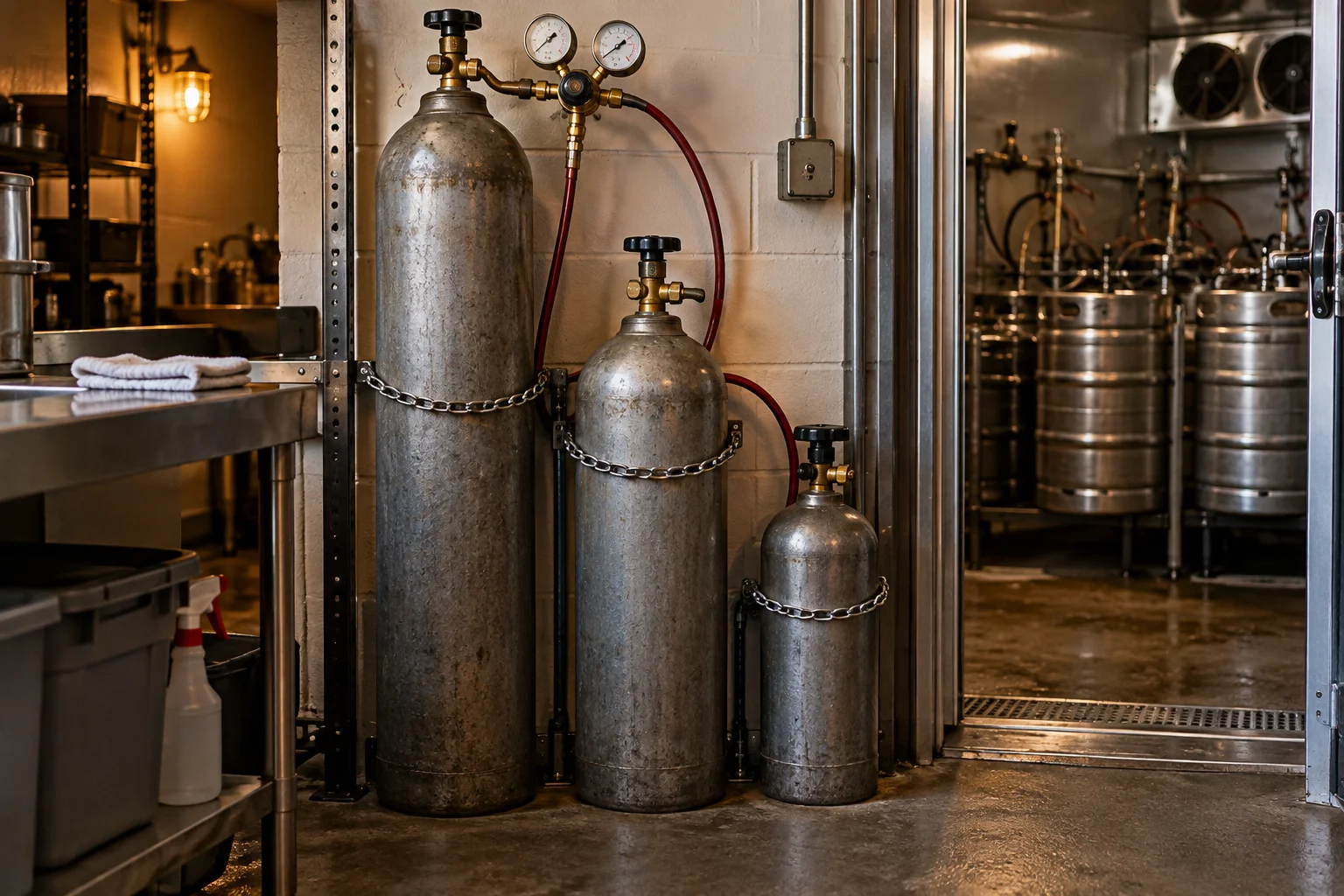
How long does a CO2 tank last? It depends on the cylinder size, how many kegs and soda lines you serve, and how tight your system is. A small cylinder may empty in weeks, a large one in months. Here are the numbers by size for bars that depend on Beverage Gas Supply.
How long does a CO2 tank last?
Two things wear out: the gas and the cylinder. How long CO2 lasts comes down to how much gas leaves the tank each day. A bar that pours daily empties the same tank far faster than a hobbyist running an aquarium. An aquarium sends a slow trickle of bubbles through diffusers (small discs that break gas into fine bubbles), so one small tank can run for months. A bar draws gas every time it pours a pint, runs a soda line or changes a keg. Summer patio traffic and busy weekends pull more gas than a slow Tuesday.
So how long does a CO2 tank last in practice? Usually weeks to a few months, depending on size and volume. The cylinder itself has a much longer lifespan, often many years. It still needs re-testing on a schedule, and the test date is stamped on the cylinder's shoulder. A cylinder past its test date should not be filled, however much gas it holds. Green CO2 Systems offers ultrasonic cylinder testing in Colorado only.
What are the common CO2 tank sizes?
Cylinders are sold by the weight of gas they hold. The tables below use three common capacities, 5 lb, 10 lb and 20 lb, as general planning figures, not as a list of what Green CO2 Systems offers. Some people call them bottles, but cylinder is the proper word. Bars use these sizes on small draft systems and soda guns too. They are general market sizes, not a list of what we stock, so ask us which ones fit your account.
How long does a 5lb CO2 tank last, kegerator or bar tap?
A 5 lb tank typically dispenses about 5 to 7 half-barrel kegs when the system is tight. On a busy single tap that is a few weeks. On a slow one it is a few months. The same math applies to a kegerator CO2 tank, since the gas used per keg does not change with the setting. Leaks change the math fast, because a loose fitting can drain a small cylinder in days. The tank is easy to move, but it needs the most swaps, so it suits low volume only.
How many kegs does a 10lb CO2 tank dispense?
A 10 lb tank usually dispenses about 10 to 14 half-barrel kegs, roughly double the 5 lb. It suits a bar with a few taps that changes kegs weekly. The extra capacity also covers carbonated beverages from a small soda line without constant swaps.
How many kegs does a 20lb CO2 tank dispense?
A 20 lb tank dispenses about 20 to 28 half-barrel kegs. A bar with several taps and a soda gun may go through one in a month or two. It is heavy when full, so move it with a hand truck and chain it upright to a wall.
How many kegs can you get from one CO2 tank?
A half-barrel keg holds about 58 liters of beer (15.5 gallons). As beer leaves the keg, CO2 takes its place, so every liter you pour costs some gas. These planning numbers assume half-barrel kegs, a tight system and no forced carbonating.
| Tank size | Half-barrel kegs, tight system | Best fit |
|---|---|---|
| 5 lb | about 5 to 7 | One or two taps, slow volume |
| 10 lb | about 10 to 14 | A few taps, weekly keg changes |
| 20 lb | about 20 to 28 | Several taps plus a soda gun |
Treat these as rules of thumb, not guarantees. A warm cooler, a high serving pressure or a slow leak can cut the totals in half. Smaller kegs use less gas each, so count liters if your lineup is mixed: a sixth-barrel keg holds about 19.5 liters.
Which CO2 tank size should you buy?
Choosing between CO2 tank sizes starts with kegs per month. Say your bar changes 8 kegs a month. A 5 lb tank would be gone in under a month, a 10 lb tank in about six weeks, and a 20 lb tank in two and a half months or more. Count your soda lines too, since they draw from the same supply. Asking how long does a CO2 tank last for your bar only works with your own keg count.
Pick the smallest size you will not have to swap constantly, and the largest one you can store safely and lift. A back room with little floor space favors smaller cylinders. Unlike an aquarium setup, a bar cannot wait a week for gas, so leave room for a spare. A bar swapping a 20 lb tank more than once a month may want to ask about micro bulk CO2 instead.
How do you know when a CO2 tank is running low or empty?
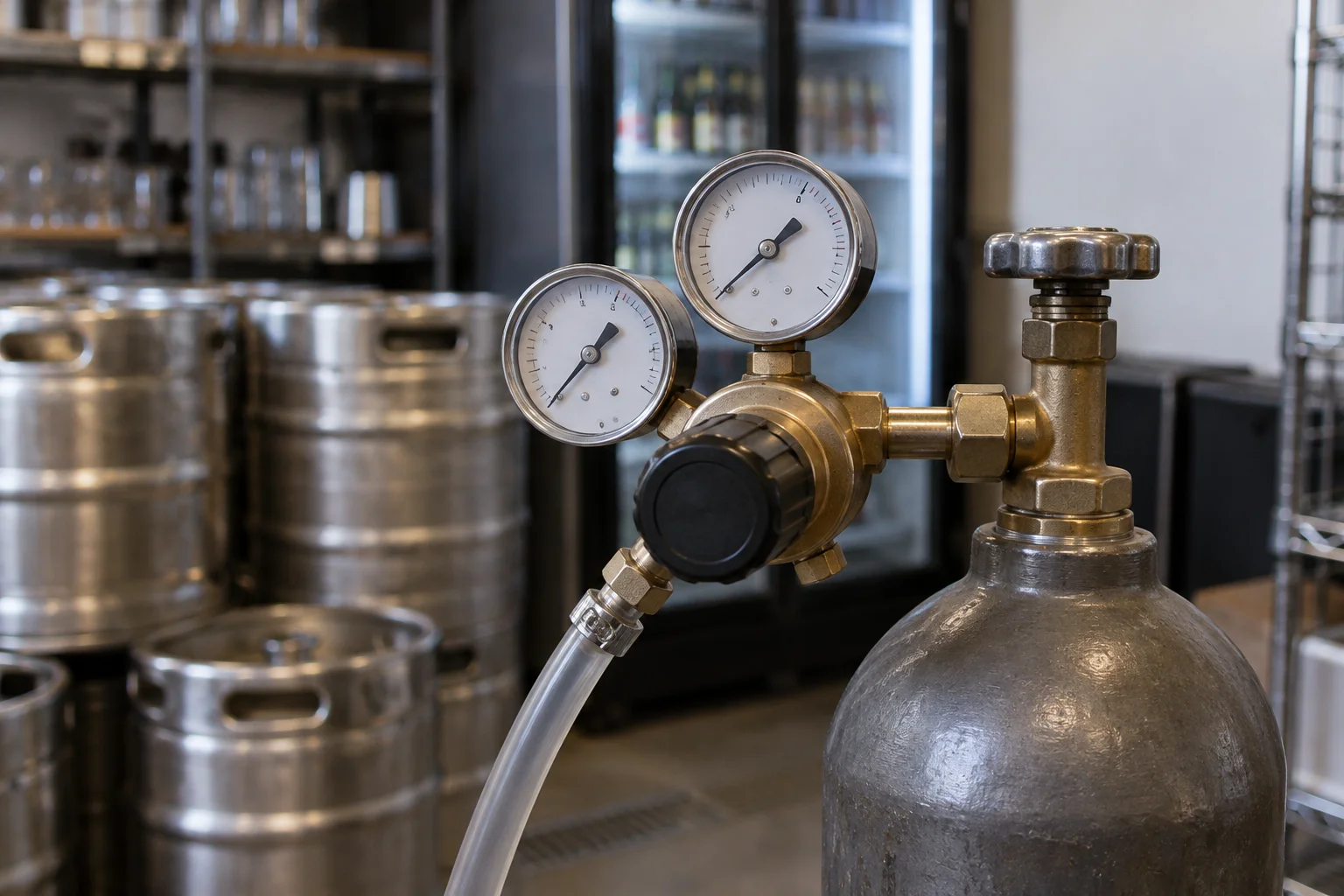
Carbon dioxide sits in the cylinder as a liquid with gas above it. As you draw gas, liquid boils off to replace it, so the pressure stays near 800 psi at room temperature until the liquid is almost gone. Most regulators have two pressure gauges, one for the cylinder and one for the line. The cylinder gauge looks fine for weeks, then drops fast. By then you are nearly out.
A better check is weight. The empty (tare) weight is stamped on the cylinder. Subtract it from the scale reading to get the pounds of CO2 left. Other warning signs are beer that pours foamy or flat and soda that loses its bubbles.
What makes a CO2 tank run out faster than expected?
How long does a CO2 tank last when something is wrong? Often half as long as the table says. Most early empties trace back to a short list:
- Leaks: A worn washer or loose fitting bleeds gas all night. Brush soapy water on each joint. Bubbles mean a leak.
- Warm coolers: Warm beer foams, and foam wastes gas.
- High serving pressure: More pressure than the beer needs pushes more gas into every keg.
- Venting and forced carbonating: Bleeding a keg or carbonating it with gas uses far more than serving does.
- A valve left open: An open valve on an unused line keeps draining the tank.
A leak is also a safety issue. CO2 is heavier than air and settles in low spots, so fix leaks quickly and keep back rooms ventilated. A CO2 monitor senses rising levels and sounds an alarm.
Can you refill a CO2 tank instead of buying a new one?
Green CO2 Systems handles refill through CO2 Tank Refill by Cylinder Exchange. You swap an empty Green CO2 Systems cylinder for a full one that has already been filled, so you skip the wait while a tank is filled. The cylinder you swap belongs to Green CO2 Systems. What it costs depends on cylinder size and account type, so ask us rather than guess.
Plan Your Bar's CO2 Supply With Our Team
Tell us your taps, soda lines and weekly kegs, and Green CO2 Systems will help you match a cylinder exchange schedule to how you pour. Contact Us to start the conversation.
Common questions
It depends on tank size and how much you pour. A small cylinder on a busy tap may need a swap every few weeks, while a larger one in a slow bar can last a few months. Count your kegs per month, compare that with the planning table above, and weigh the cylinder instead of trusting the gauge alone. Swap before it reads empty.
In a tight system, a 20 lb tank dispenses about 20 to 28 half-barrel kegs. A bar that changes 8 kegs a month would get roughly two and a half months or more from it. Soda lines, leaks and a warm cooler shorten that. A busy bar with several taps and a soda gun may go through one in a month or two.
Look for the test date stamped on the cylinder's shoulder. A cylinder past that date needs re-testing before anyone fills it. The gas itself does not spoil, so an old date is about the metal, not the contents. Green CO2 Systems offers ultrasonic cylinder testing in Colorado only, so if you own a cylinder, check its test date with whoever services it.
Liquid CO2 boils off to keep the pressure steady, so the cylinder gauge holds near 800 psi until the liquid is nearly gone. Then it drops fast. Weigh the cylinder against the tare weight stamped on it for a truer reading, and plan your swap before the gauge moves at all.
Written by Green CO2 Systems
Green CO2 Systems develops and assembles its own patented equipment and supplies micro bulk CO2, nitrogen and blended beverage gas from depots in Oklahoma City, Denver, Fort Collins and Las Vegas.