
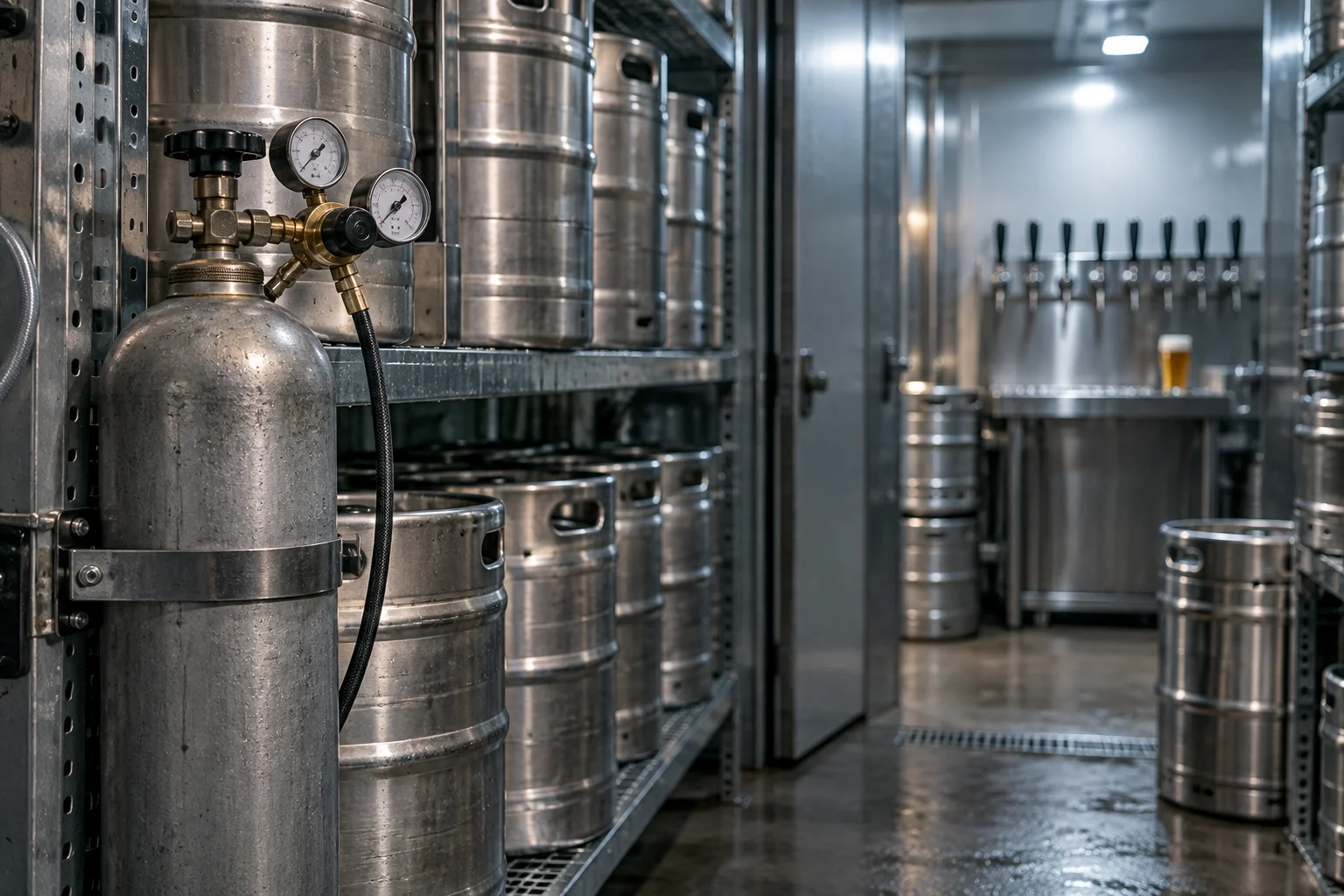
Most draft beer settles at a keg CO2 pressure of about 8 to 14 psi (pounds per square inch) when the keg is kept near 38°F, but the right number depends on the beer style and the cooler temperature. Here is the chart and the math, from the team that provides Beverage Gas Supply to bars and breweries pouring draft beverages.
What Is the Right Keg CO2 Pressure for Draft Beer?
The right CO2 pressure for a beer keg is the setting that holds the beer at its intended carbonation while it sits in your cooler. Brewers measure carbonation in volumes of CO2, a ratio of dissolved gas to beer. Most ales land between 2.2 and 2.6 volumes. Lagers run a little higher.
Two things decide the number: the carbonation volume you want and the beer's temperature. Cold liquids hold more gas at the same pressure, so a colder cooler needs a lower setting. That pressure temperature link is why no single psi works for every tap. At 38°F, ales sit near 8 to 12 psi and lagers near 10 to 14 psi, so the ideal gas pressure for keg beer is a range, not one figure.
What Is the Keg CO2 Pressure Chart by Temperature in PSI?
This keg CO2 pressure chart gives gauge psi for three common carbonation volumes at five beer temperatures.
| Beer temperature | 2.0 volumes (stouts, British ales) | 2.4 volumes (ales, IPAs) | 2.8 volumes (pilsners) |
|---|---|---|---|
| 34°F | 4.3 psi | 8.2 psi | 12.1 psi |
| 36°F | 5.1 psi | 9.2 psi | 13.3 psi |
| 38°F | 6.0 psi | 10.2 psi | 14.4 psi |
| 40°F | 6.8 psi | 11.2 psi | 15.5 psi |
| 45°F | 9.0 psi | 13.7 psi | 18.4 psi |
Find your beer temperature on the left, then slide across to the carbonation volume you want. A 38°F keg of a standard ale at 2.4 volumes wants about 10 psi. If the cooler drifts to 42°F, that same beer needs about 12 psi to hold its carbonation.
Please note that the chart reads gauge pressure at sea level. Beer absorbs gas based on absolute pressure, and the air pressing on the keg thins out as you climb, so adjust your settings by adding roughly 0.5 psi for every 1,000 feet.
How Do You Use a Keg Pressure Calculator?
A keg pressure calculator needs three inputs and returns one number. Enter the beer's temperature, the carbonation volume for the style and your elevation. The result is the psi to set on the regulator, the device that steps cylinder pressure down to serving pressure. Measure the temperature inside the cooler with a thermometer instead of trusting the dial, because the setpoint and the beer often differ by a few degrees, especially in walk-in coolers that get opened often.
How Does a Beer Carbonation Calculator Work?
A beer carbonation calculator solves the same equation as the chart. Gases dissolve into liquids in proportion to pressure, and more readily as the liquid gets colder. The calculator takes your temperature and target volumes, then solves for the pressure that keeps that much CO2 in the beer. Every beer carbonation calculator uses the same physics, so its answer should match the chart at the listed temperatures. If it does not, check that the tool returns gauge psi and not absolute pressure.
What Keg CO2 Pressure Should I Set for Each Beer Style?
Style decides the carbonation volume, and the volume decides the pressure. These pressures are typical targets, and tastes vary by recipe, so treat them as a starting point. The psi figures are for a 38°F keg at sea level.
- Stouts and British-style ales: 1.8 to 2.3 volumes, about 4 to 9 psi.
- Most ales, including pale ales and ambers: 2.2 to 2.6 volumes, about 8 to 12 psi.
- Pilsners and other lager styles: 2.4 to 2.8 volumes, about 10 to 14 psi.
- Wheat beers and Belgian-style ales: 3.0 volumes and up, about 16 psi and higher.
Nitro stouts are a separate case. They pour on a blend of two gases, nitrogen and CO2, so their pressure comes from the gas mix and not from this chart.
What Is the Best CO2 Pressure for IPA?
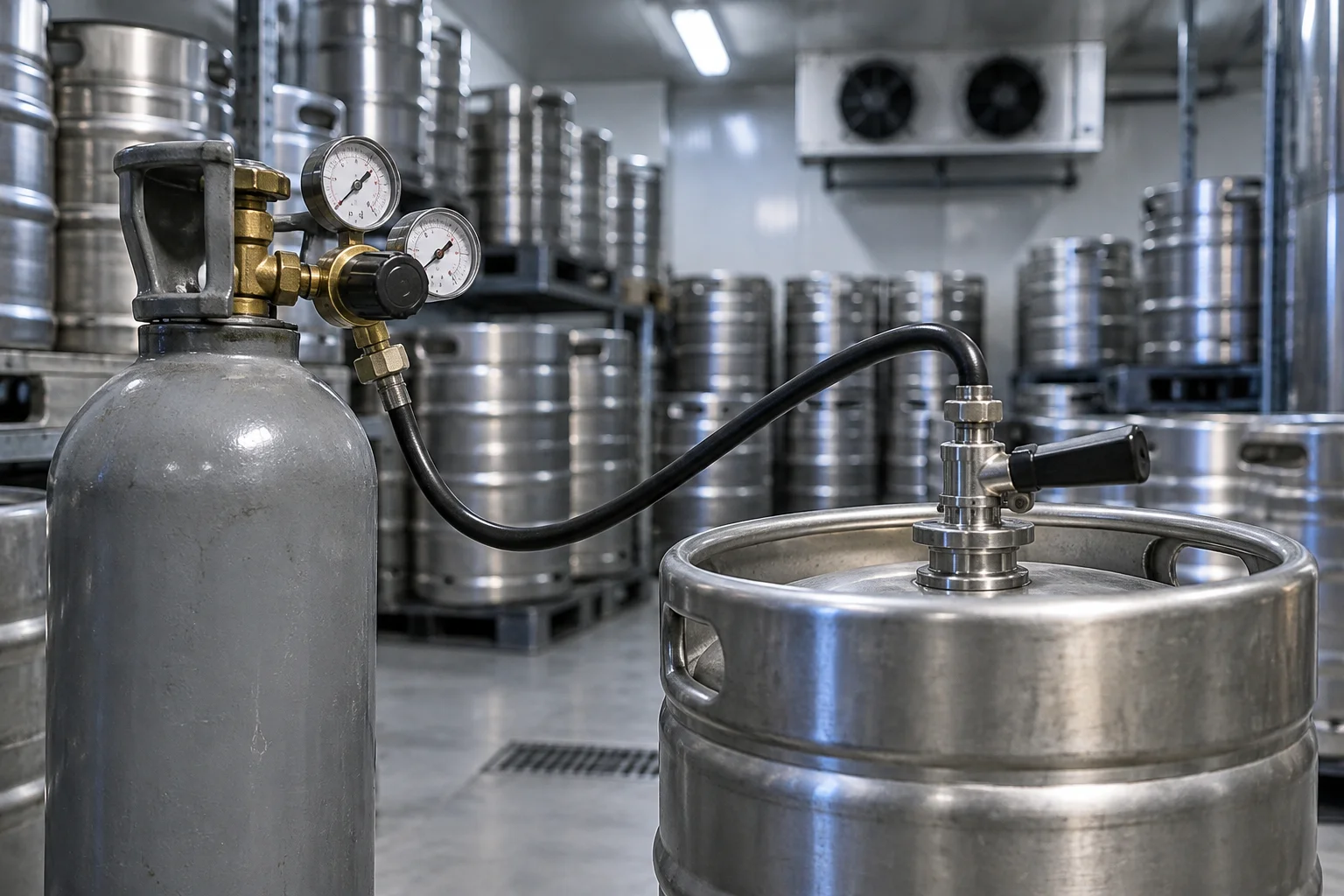
For most IPAs, the best CO2 pressure for IPA is about 8 to 11 psi at 38°F, which equals 2.2 to 2.5 volumes. Many brewers pick the lower half of that range for hoppy beers, since lower carbonation levels let hop aroma lead and keep the beer from tasting sharp. Start near 10 psi in a 38°F cooler, check the pour after two days and move one psi at a time from there.
Where Can I Find a Carbonation Chart in Celsius?
Most walk-in coolers hold beer between 2°C and 4°C, roughly 36°F to 39°F. This carbonation chart in Celsius covers a typical ale at 2.4 volumes:
- 2°C: about 9.0 psi (0.62 bar)
- 4°C: about 10.8 psi (0.74 bar)
- 6°C: about 12.6 psi (0.87 bar)
For other volumes, multiply Celsius by 1.8 and add 32 to get Fahrenheit, then read the table above.
How Do I Convert Keg PSI to Bar or kPa?
One psi equals 0.0689 bar, or 6.89 kPa. Multiply psi by 0.069 for bar and by 6.9 for kPa. Common settings:
- 10 psi: 0.69 bar, 69 kPa
- 12 psi: 0.83 bar, 83 kPa
- 14 psi: 0.97 bar, 97 kPa
- 30 psi: 2.07 bar, 207 kPa
What Happens If Keg CO2 Pressure Is Too High or Too Low?
When keg CO2 pressure runs too high, the beer slowly climbs above its intended carbonation levels. You get a foamy pour, a keg that gushes when you open the tap and a beer that tastes sharp and bitey.
When the pressure runs too low, the beer gives up gas and goes flat over several days. Low pressure can also let dissolved gases break out inside the line, which causes foam at the faucets and a slow, spitting pour.
Before you change the regulator, check three things in order: beer temperature, gas supply, then the lines and faucets. A warm keg foams at the faucets even at the correct psi. An empty cylinder also looks fine on the high-pressure gauge until the liquid CO2 is nearly gone. Breweries avoid that surprise with a spare cylinder and a regular swap schedule from a Brewery Gas Supplier, which turns an empty cylinder into a planned exchange instead of a bad night on the taps.
Should Serving Pressure Be Different From Carbonation Pressure?
Often the two pressures are the same number. Carbonation pressure sets how much gas the beer holds, and serving pressure pushes beer from the keg to the faucets. In a balanced system one setting does both jobs, so the chart value is also the serving value for most draft beer.
They differ in two cases. The first is force carbonating: you run high pressure for a short time to speed up forced carbonation, then drop to the chart value for serving. The second is a long run between cooler and tap, where the system may need more push than the chart gives. Raising CO2 pressure to fix that over-carbonates the beer, so let a draft system designer solve it with the line layout or the blend of gases.
Match Your Gas Supply to Your Draft Pressure
A pressure chart only helps when the gas supply for your draft beverages is planned, and Green CO2 Systems fills its own cylinders for bars, restaurants and breweries by exchange, so empty bottles are swapped for full ones. Our office is open Monday to Friday, 8 am to 4 pm Mountain, and to talk through cylinder exchange or Micro Bulk CO2 for your taps, start with the Contact Us page.
Common questions
For most draft beer in a 38°F cooler, a keg CO2 pressure between 10 and 14 psi is the usual range, with ales near the low end and pilsners near the high end. Beers differ, so use the chart above for your exact temperature and carbonation levels, and add about 0.5 psi for every 1,000 feet of elevation.
Yes, you can force carbonate at 30 psi to speed up forced carbonation, but it is easy to overshoot. Brewers hold that pressure for a day or two, then vent the headspace and drop back to serving settings.
At 12 psi and about 38°F, a still keg usually needs a week or more to reach full carbonation, because gas dissolves slowly from the top of the beer. Rocking the keg or raising the pressure briefly speeds up forced carbonation. The beer settles near 2.6 volumes at that pressure and temperature.
CO2 cylinders hold liquid CO2 under pressure. At room temperature the high-pressure gauge reads roughly 800 psi or more while any liquid remains, then drops fast once the liquid is gone. The regulator steps the pressure down to the 10 to 14 psi range most draft beer needs.
Written by Green CO2 Systems
Green CO2 Systems develops and assembles its own patented equipment and supplies micro bulk CO2, nitrogen and blended beverage gas from depots in Oklahoma City, Denver, Fort Collins and Las Vegas.