
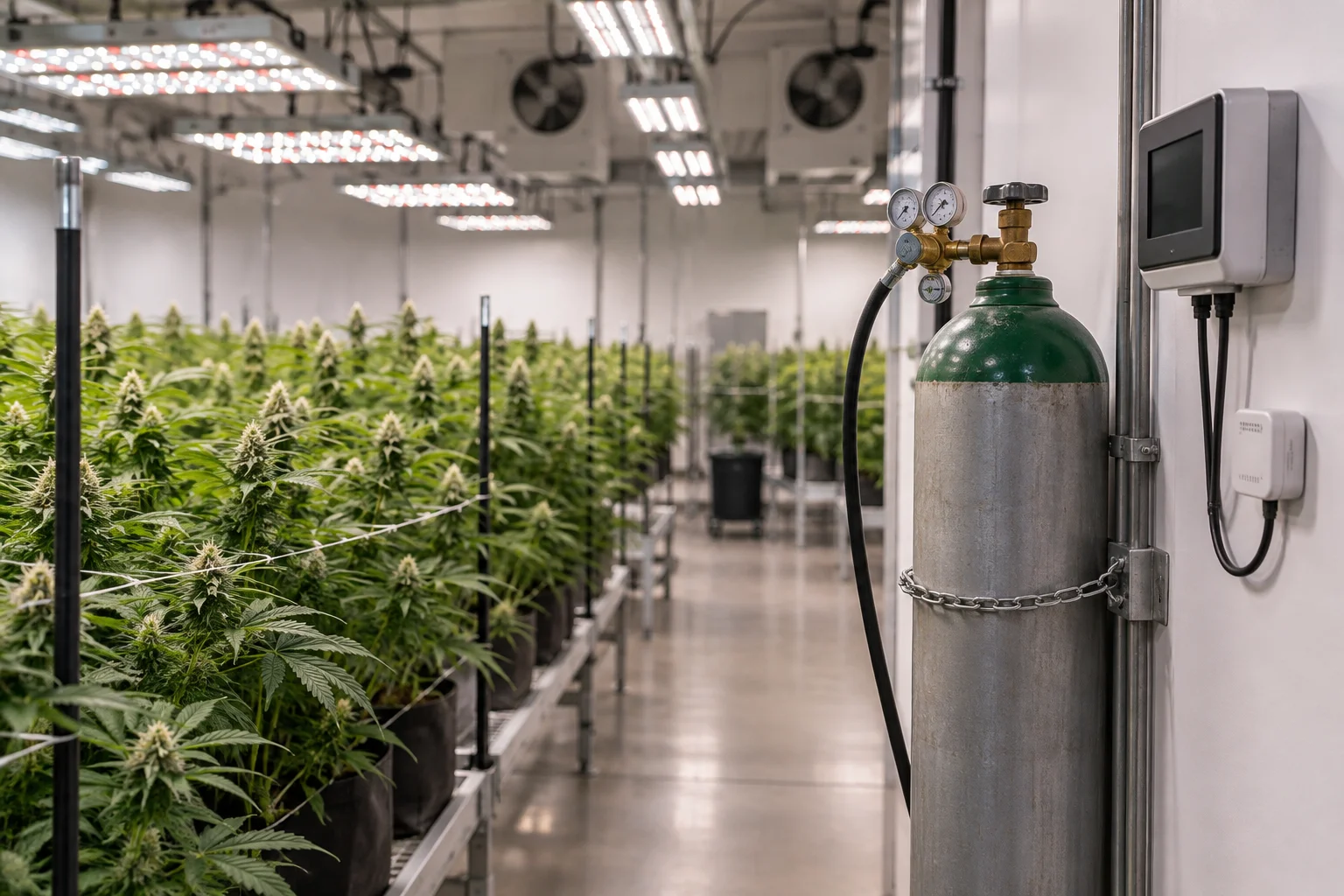
In the CO2 burner vs tank debate, the tank wins on heat and humidity, the burner can cost less to run in big rooms, and safety depends on the room and how each setup is managed. A tank adds pure carbon dioxide and nothing else, which is why a CO2 System for Grow Rooms often starts with cylinders.
| What you compare | CO2 tank | CO2 generator |
|---|---|---|
| CO2 source | Pure CO2 from a cylinder | CO2 from burning natural gas or propane |
| Heat added | None | Yes, from the flame |
| Humidity added | None | Yes, water vapor comes with every burn |
| Byproducts | None | Water vapor, heat, and carbon monoxide if the burn is poor |
| Installation | Tank, regulator, hoses, controller | Fuel line, combustion air and exhaust plan, controller |
| Best fit | A tent or small sealed room | A large room with strong cooling and dehumidifying |
CO2 burner vs tank: which is better for a grow room?
Neither wins everywhere. The better pick depends on your grow room size, how tight the room is, and how much extra heat your cooling can absorb.
Growers use CO2 indoors because plants under strong light can pull carbon dioxide out of a sealed room faster than leaks replace it. Outdoor air holds roughly 400 ppm (parts per million) of carbon dioxide. CO2 enrichment raises that level, and many growers aim for about 1,000 to 1,500 ppm while the lights are on. A controller reads the sensors and opens a valve or fires the generator to hold the target. The real decision is where the gas comes from: a cylinder or a flame.
Is a CO2 generator the same thing as a CO2 burner?
In practice, yes. Sellers use the two words loosely, and both describe equipment that burns fuels such as natural gas or propane to make CO2. Every unit also releases heat and water vapor, so the trade-offs below apply to CO2 generators and burners alike. A tank is different. It stores CO2 and burns nothing.
How much heat and humidity do CO2 burners and generators add to a grow room?
Burning fuels makes three things at once: CO2, water vapor and heat. You cannot get the first without the other two. Chemistry sets the water amount. Natural gas, which is mostly methane, gives off about 0.8 pounds of water for every pound of carbon dioxide it makes. Propane gives off about 0.5 pounds. That water lands in your room air, and your dehumidifier has to remove it.
Heat works the same way. Your lights already load the cooling system, and the flame stacks more on top. In a Las Vegas summer, when air conditioning is already running hard, that extra load matters. A tank adds neither heat nor water, because gas leaving a tank is just gas.
Poor combustion creates another problem. A dirty or air-starved unit can release carbon monoxide and other gases. Units used indoors also need a plan for combustion air and exhaust, and the manufacturer's instructions govern that installation.
Do CO2 burners raise grow room humidity and temperature?
Yes, both. Compare your readings before and after you add the unit. If relative humidity and room temperature climb together, the flame is the likely cause. Extra humidity can push a room off its target and raise mold risk in a dense canopy, which can cut yield. A tent shows this first, since it holds little air to absorb the heat and water.
Are CO2 tanks safer than CO2 burners and generators?
Tanks remove several hazards and keep one. Combustion brings an open flame, a fuel line that can leak, carbon monoxide and heat. A tank brings a high-pressure cylinder and the chance of a CO2 leak in a closed room.
Which risk is bigger depends on the room. A natural gas leak is a fire and explosion risk. A CO2 leak does not burn, but it displaces oxygen, and like other gases heavier than air it settles low. Rising concentrations cause headache and dizziness, and much higher concentrations cause unconsciousness. OSHA's permissible exposure limit is 5,000 ppm averaged over eight hours, and NIOSH lists 40,000 ppm as immediately dangerous to life or health. Enrichment targets of 1,000 to 1,500 ppm sit well under both. Using CO2 indoors safely means one sensor where people breathe and one low in the room, whichever source you pick.
Is a CO2 tank explosive?
A CO2 cylinder is not explosive the way a fuel tank is, because carbon dioxide does not burn. It is still under pressure. A damaged valve can turn it into a projectile, and heat raises the pressure inside. Chain tanks upright, keep them away from heat, leave valve caps on during moves, and check the regulator and valve for leaks.
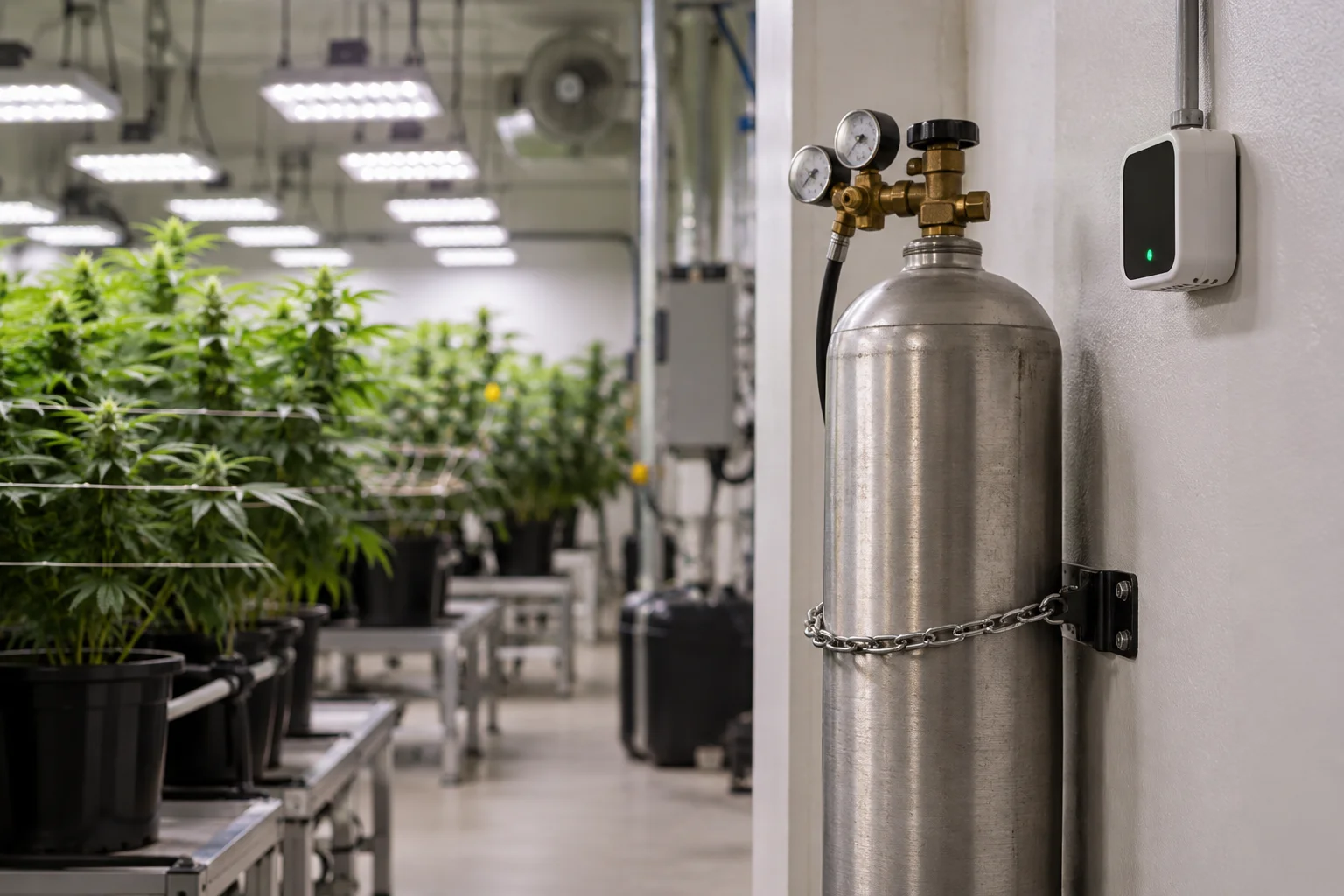
Is a CO2 tank 20 lb or a CO2 tank 50 lb right for your grow room size?
Search results list tanks by weight, so growers ask about 20 lb and 50 lb. Those are common shopping sizes, not a list of what we supply. The weight is the pounds of CO2 inside.
One pound of CO2 becomes about 8.7 cubic feet of gas. A CO2 tank at 20 lb holds roughly 174 cubic feet, and a CO2 tank at 50 lb holds roughly 435. Here is the surprise: filling a room takes very little. A room 10 by 10 by 8 feet holds 800 cubic feet, and raising it by 1,000 ppm takes about 0.8 cubic feet, under a tenth of a pound. Tanks empty through air loss, door openings and vented air, not through the first fill.
So the sizing rule is simple. A smaller tank suits one tent or a tight small room. A larger one suits a big room, several rooms or a loose space, because it means fewer swaps. Ask us which sizes fit your site.
How long does a CO2 tank last in a grow room?
There is no honest single number, because the room decides. The formula is days equals pounds of CO2 in the tank divided by pounds used per day. Five things drive daily use: room volume, how tight the room is, your target level, the hours the lights are on, and how much air your fans exhaust. A sealed grow room stretches a tank the furthest. A vented room drains it fastest because enriched air leaves. As an example only, a room that uses 2 pounds a day empties 20 pounds in 10 days. Your controller log and sensor readings over the first two weeks give you a real number.
CO2 generator vs tank: which costs less to run?
The CO2 burner vs tank cost gap depends on room size, and the price of the gas is only part of it. These are the cost drivers:
- Fuel or gas: generators burn fuels like natural gas or propane, which can cost less per pound of CO2 in a large room. A tank uses CO2 supplied by exchange.
- Cooling and dehumidifying: a generator adds heat and water you pay to remove. A tank adds neither.
- Maintenance: generators need cleaning, fuel line checks and a clean air supply. Tanks need leak checks on the regulator, hoses and valve.
- Room tightness: a loose room wastes gas under either source.
- Installation: fuel lines and exhaust need more work than a rack for tanks.
In a tent or small room, a tank often costs about the same or less once cooling is counted. In a large room with spare cooling, a generator can win on running cost.
How much is a CO2 tank refill?
At Green CO2 Systems, supply comes by cylinder exchange. We fill only our own cylinders, and you swap an empty one for a full one. The cost depends on the sizes you swap, how often you swap and your account. We quote it for your site instead of publishing a number, because swap frequency changes the answer.
Which CO2 setup works best for sealed grow rooms versus vented grow rooms?
Use these rules by situation:
- Tent or small sealed room: pick a tank. Heat and humidity matter most in small spaces, and a tank adds neither.
- Large sealed room with strong cooling and dehumidifying: a generator can work if a qualified installer handles the fuel line, air supply and exhaust. A tank works here too.
- Vented room: enrichment gets diluted because exhaust fans move enriched air out. Many growers pause or throttle the fans while enriching, and the controller holds the target.
- Several grow rooms or a whole building: ask about micro bulk CO2 instead of rows of tanks.
- Any room people enter: add CO2 sensors with an alarm, whichever source you pick.
Our verdict
For most single-room and tent growers, pick the tank. It adds no heat, no humidity and no exhaust gases, but a high-pressure tank still brings its own hazards to manage, a leak and a damaged valve, so it needs secure mounting and a CO2 monitor. Pick a generator only for a large room with spare cooling, a tight envelope and a qualified installer. In the CO2 burner vs tank question, the tank is the default and the generator is the exception.
If a tank fits your room, tell us your room size and what level you want to hold, and we will talk through how CO2 Tank Refill by Cylinder Exchange would work at your site.
Talk Through Your Grow Room Setup With Green CO2 Systems
Tell us about your room, your target level and your current setup, and we will help you weigh tanks against combustion. Our office hours are Monday to Friday, 8 am to 4 pm Mountain, so reach the team through Contact Us.
Written by Green CO2 Systems
Green CO2 Systems develops and assembles its own patented equipment and supplies micro bulk CO2, nitrogen and blended beverage gas from depots in Oklahoma City, Denver, Fort Collins and Las Vegas.