
Skip to content
Green CO2 Systems

CO2 tank refill cost and other first-call questions

The co2 tank refill cost question comes up first almost every time, so it is answered first. Everything below is what people actually ask, in the order they ask it.

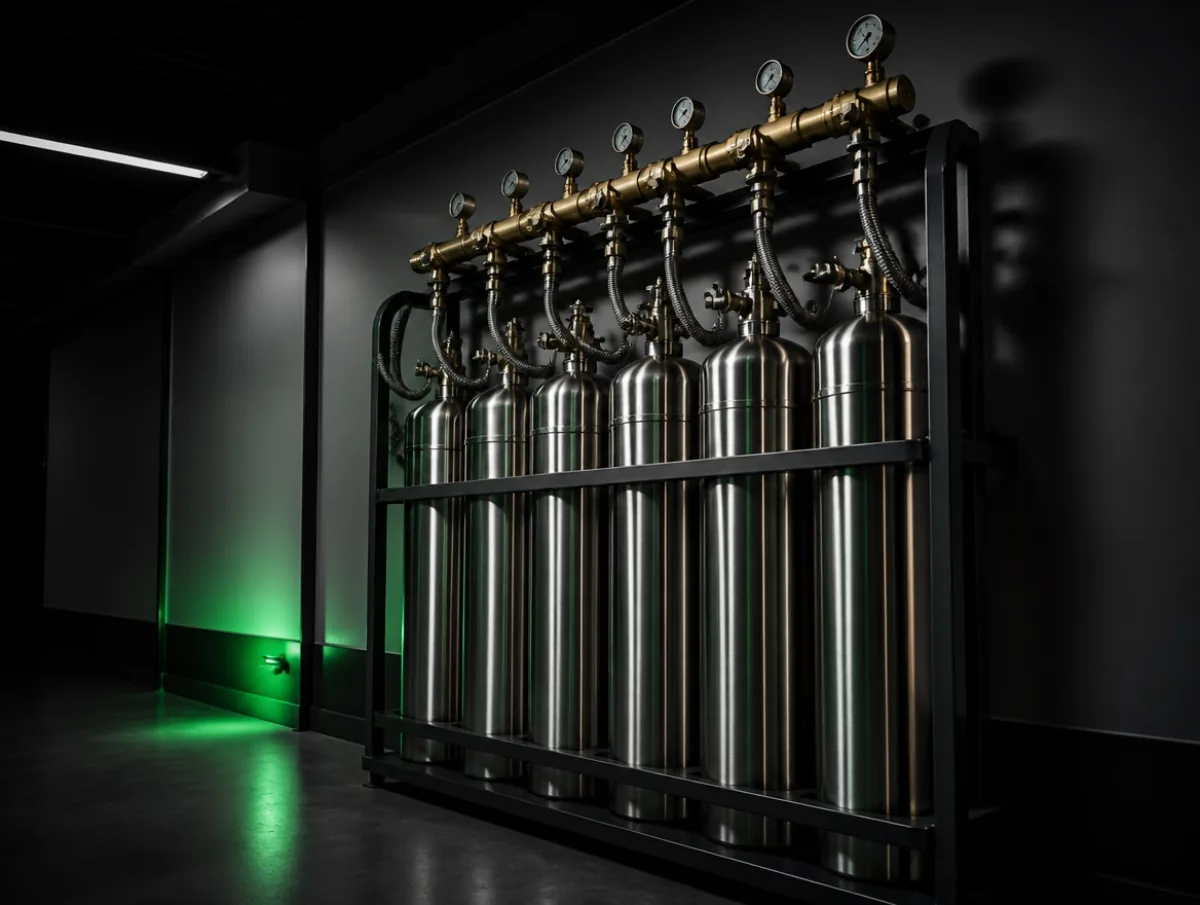
A bank of polished stainless steel high pressure CO2 cylinders in a steel frame, connected by braided hoses to a brass manifold with pressure gauges.

Why we do not publish a price list

Because any number we published would be wrong for most people reading it. CO2 cost depends on cylinder size, monthly volume, delivery frequency, how far you are from a depot and whether you are on cylinders or bulk. A site using four cylinders a week and a site using four a month are not comparable.

What we do instead is measure. The free assessment produces a real figure for your site, and it also tells you what you are currently losing to venting, which is frequently the larger number.

The question that matters more than price per refill

Not what a refill costs, but what fraction of it you actually use. Conventional bulk systems vent off gas continuously as pressure builds, and on a low-turnover site that can be approximately 30 percent or more of a delivery.

A cheaper price per pound on a system that vents a third of it is not cheaper. This is the single most common thing we find when we take over an account.

Speak with a Territory Sales Manager

The assessment costs nothing and produces a figure you can actually budget against.

Commercial CO2 information without a sales call

Most commercial CO2 information online is either a manufacturer spec sheet or a form gate. Neither helps an operator trying to work out whether their current setup is costing them money.

Everything here is readable without giving us your details, because a supplier who will only answer basic questions in exchange for a lead is telling you something about how the account will run.

What CO2 refill price actually depends on

The cost of CO2 tank refill work varies with cylinder size, volume, frequency and distance from a depot. Anyone quoting a flat CO2 refill price without asking those questions is guessing.

How much does a CO2 refill cost is therefore the wrong first question. The cost to refill CO2 tank stock matters far less than what fraction of it reaches a glass.

A bank of polished stainless steel high pressure CO2 cylinders in a steel frame, connected by braided hoses to a brass manifold with pressure gauges.
High pressure bulk storage stays fully enclosed. Nothing vents between fills.

Questions about switching supplier

Changing gas supplier sounds disruptive and usually is not. These are the concerns that come up once price is settled.

Do we have to close?

Almost never. Work is staged around your business hours and the existing supply keeps running until the new system is live.

What happens to our current cylinders?

If they belong to your existing supplier, they go back to them. Either way you move onto our own cylinders, because we only fill our own.

Are we locked in?

Terms are set per account. Ask your account manager to walk through the agreement before you sign rather than after.

What if our volume changes?

Systems are specified with headroom appropriate to your growth. Tell us about planned expansion during the assessment rather than afterwards.

Common questions

It depends on cylinder size, volume, delivery frequency and distance from a depot, so we quote per site. The free assessment gives you a real figure for your usage rather than a number that would be wrong for most people.

Cylinder exchange means we bring full bottles and take empties. Bulk means permanent storage in your building that we fill from an outside box, so nobody handles a cylinder at all. Bulk usually makes sense past several cylinders a week.

Yes. After-hours call-outs to our on-call service technicians carry an emergency delivery fee. Telemetry and a schedule built from measured usage are how we keep those calls rare.

Six metros from four depots: Denver, Fort Collins, Colorado Springs, Oklahoma City, Tulsa and Las Vegas, plus the surrounding corridors. If you are outside those, call us and we will tell you honestly whether we can serve you well.

No. We only fill our own cylinders and supply them on exchange. Moving onto our stock means no turnaround wait and no test dates for you to track.

Deliveries run on a schedule built from your measured usage, so running out should be rare. If it happens, call us. Existing customers can reach our on-call service technicians after hours, and an emergency delivery fee applies to after-hours call-outs.

If CO2 is stored in an enclosed occupied space, almost certainly, and in most jurisdictions it is a code requirement. We install to the configuration your local authority expects.

Yes. Food-grade nitrogen in cylinders or generated on site, and pre-set CO2 and nitrogen blends held to plus or minus 2 percent.

Usually gas blend or line balance rather than the beer. On a long draw line, straight CO2 at the pressure needed to move the beer will over-carbonate it in transit. The fix is a correctly specified blend.

We supply beverage-grade CO2, which is high-purity concentrated CO2 certified for food and drink contact, in cylinders or into a bulk system. If you are asking about a specific concentration or grade for an extraction or industrial process, tell your Territory Sales Manager the application and we will confirm what we can supply.

Speak with one of our Territory Sales Managers and get a Free CO2 Assessment. They look at your current setup and usage and tell you what a right-sized system would look like, including whether you need one at all.

Get a real number for your site

The assessment costs nothing and produces a figure you can actually budget against.

Call 877-CO2-FOR-UFree assessment