
Skip to content
Green CO2 Systems

CO2 tank sizes: what do you actually need?

What size co2 tank do i need is the question behind most first calls, and the honest answer is that it depends on more than your venue type. Here is how the sizing is actually worked out, so you can sanity check whatever a supplier tells you.

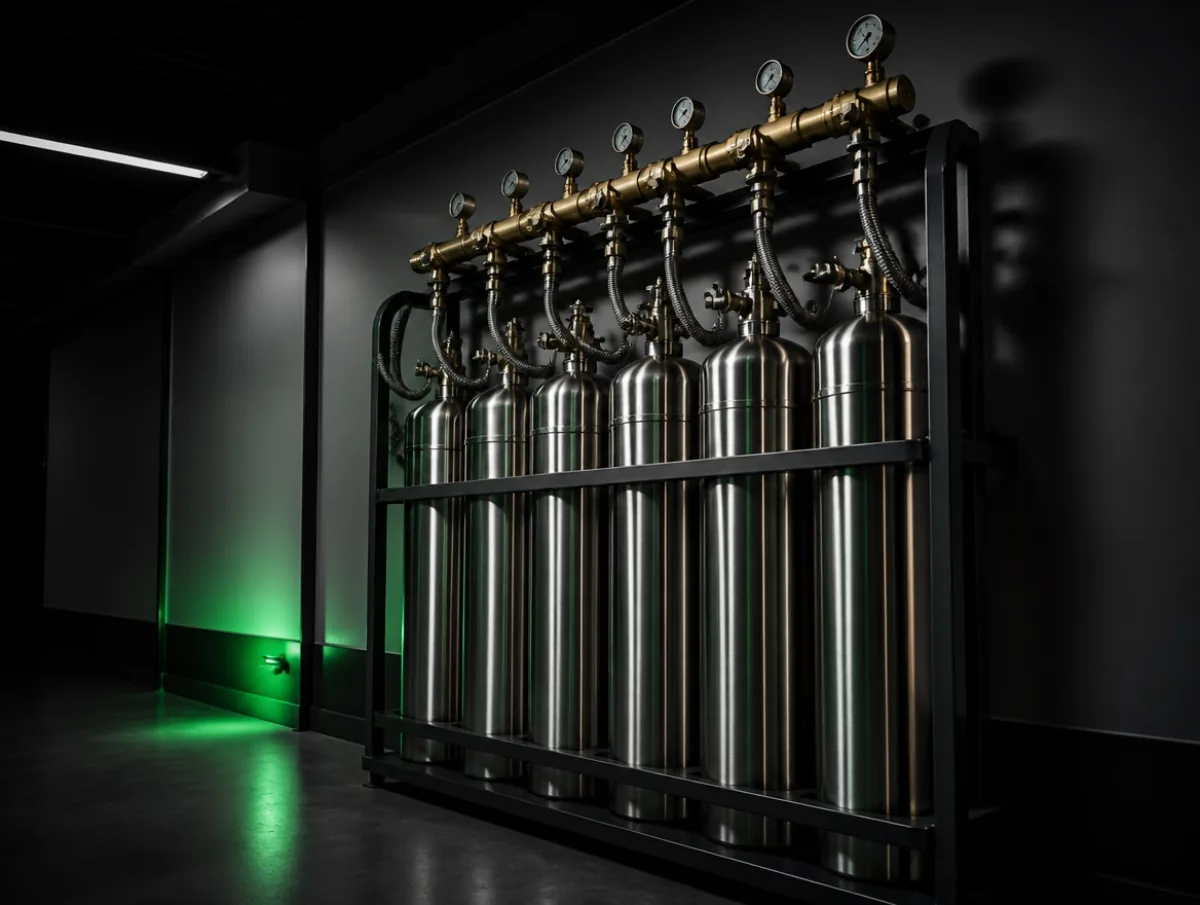
A bank of polished stainless steel high pressure CO2 cylinders in a steel frame, connected by braided hoses to a brass manifold with pressure gauges.

The four inputs that actually decide it

Venue type is a starting point, not an answer. Two bars of the same size can differ threefold in gas consumption depending on their draft-to-bottle ratio alone.

Total consumption
How much gas you get through in a normal week, measured rather than estimated
Peak draw
The fastest rate you ever pull gas, for example a brewery packaging day or a Saturday night
Delivery frequency
How often a truck can reach you, which depends on your distance from a depot
Available space
What will physically fit where the storage has to go
Why peak draw is the one people get wrong

A system sized on average monthly consumption will fail on your busiest day. Averages hide exactly the event that matters, and CO2 problems only ever happen at peak.

This is most acute for breweries, where a packaging day or a tank transfer creates a short, very large draw that a cylinder bank simply cannot deliver. Sizing on peak rather than average is the single most common correction we make.

Speak with a Territory Sales Manager

We measure consumption, peaks, space and line runs, then specify from that.

Rough starting points by venue

Use these to orient yourself, not to order equipment. Every one of them moves substantially with the specifics.

Small bar, mostly bottles
Cylinder exchange is usually right. Bulk is hard to justify
Busy bar or restaurant with draft
Bulk becomes worth costing once handling is a weekly job
Taproom with long draw lines
Bulk plus blended gas. Line length drives the blend as much as the size
Production brewery
Sized on peak draw. Packaging days dominate the calculation
Sealed cultivation rooms
Continuous consumption through the light period. Bulk with telemetry
Convenience store group
Per site sizing, but one account and one route across all of them
Commercial pool
Driven by water volume, bather load and source water alkalinity

Undersized and oversized both have a cost

Undersize and you are back to emergency deliveries, running dry at peak, and staff handling cylinders you were trying to eliminate.

Oversize and you have paid for capacity that sits idle, and on a conventional venting system you also lose more gas to venting because it sits longer between fills. On our enclosed systems that second penalty largely disappears, but the capital one does not.

A row of stainless steel conical fermentation tanks in a dimly lit craft brewery.

Line sizing is a separate question

A correctly sized tank on an undersized distribution line still gives you pressure problems at the far tap. Run length, rise and diameter all matter, and they are specified alongside the storage rather than afterwards.

How we actually measure it

The assessment looks at your real consumption across a real week of business, including your peaks, plus your space and your distance from our nearest depot. That produces a specification rather than an estimate.

If the honest answer is that you do not need a bulk system yet, we will say so and put you on cylinder exchange instead.

Why a CO2 tank size chart only gets you halfway

A CO2 cylinder sizes chart tells you what capacity exists, not what you need. Two venues with identical footprints can differ threefold in consumption on draft ratio alone.

Commercial CO2 tank size is set by peak draw, delivery frequency and available space together. Any one of those in isolation produces a system that fails somewhere.

How to measure your own consumption

You can do a rough version of this yourself before anyone visits, and it makes the first conversation far more useful.

  1. 1

    Collect three months of invoices

    Three months smooths out an unusually quiet or busy period. One month is not enough to see your pattern.

  2. 2

    Convert to pounds per week

    Total delivered pounds divided by weeks covered. This is your average, and it is the number that hides your problem.

  3. 3

    Identify your peak week

    Your busiest week of business, packaging day, or event. Peak is what the system must cover, not the average.

  4. 4

    Note how often you ran low

    Every emergency call in that period is evidence the current sizing or schedule is wrong.

Signs your current sizing is wrong

You do not need a survey to spot most of these. If two or more are true, the system is not sized for how you actually trade.

  • You have called for an emergency delivery more than twice this year
  • Somebody changes a cylinder during service rather than before or after it
  • Storage for full and empty bottles has taken over space you need for something else
  • The far tap pours differently from the near one at peak
  • You order on a calendar reminder rather than on a level reading

Common questions

A chart gets you within an order of magnitude. It cannot see your peak draw, your line runs or your space, which is where sizing actually goes wrong.

Systems are specified with headroom appropriate to your growth, and can usually be extended. Tell us about planned expansion during the assessment rather than after.

No. Oversizing costs capital and, on conventional venting systems, increases venting loss because gas sits longer between fills.

Get sized properly, for free

We measure consumption, peaks, space and line runs, then specify from that.

Call 877-CO2-FOR-UFree assessment